
Artist Feature: Ian Hatcher
by Halleta Alemu
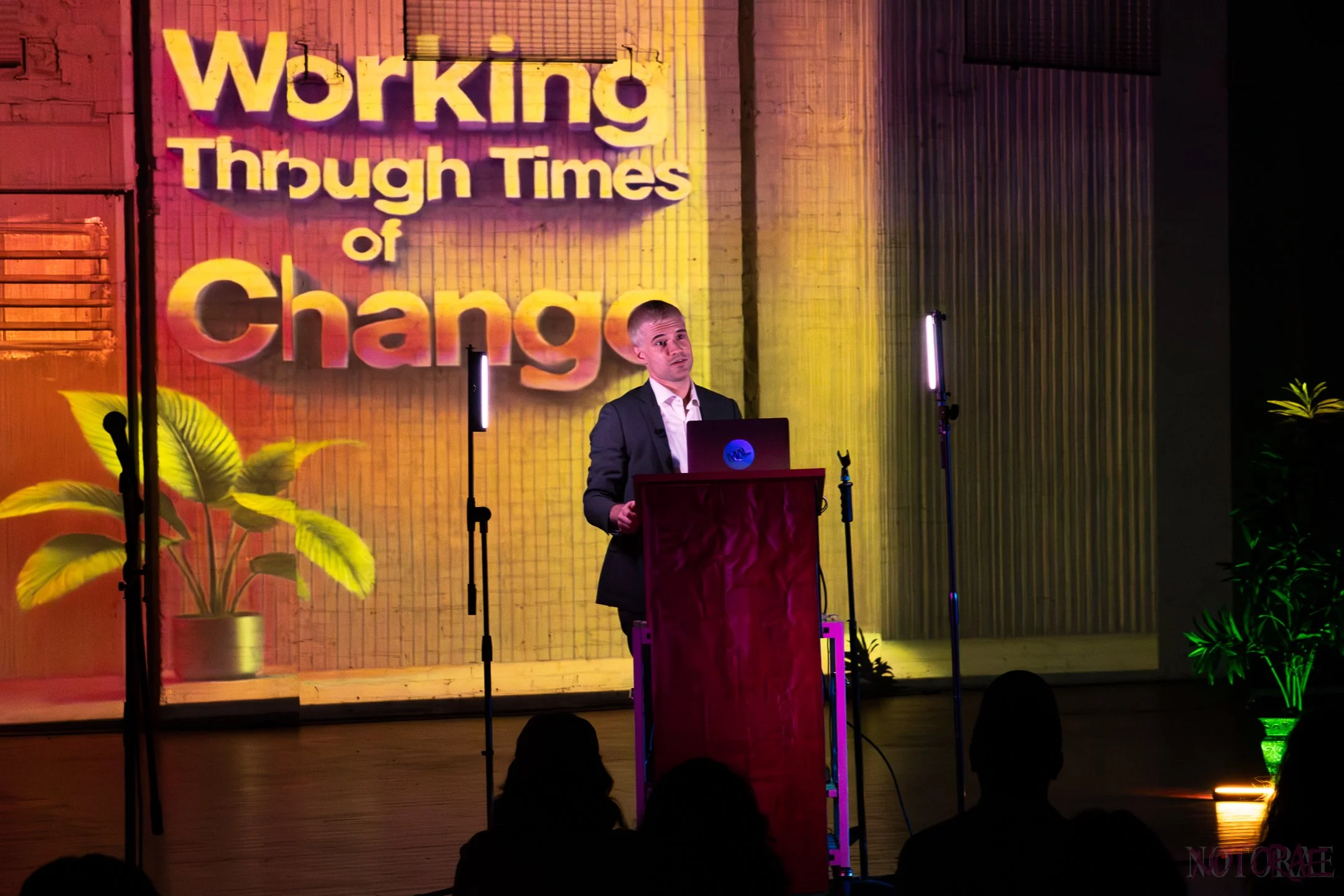
The 2025 festival performances took place at the Denver Armory and opened with Working Through Times of Change, a performance by text/sound/code artist and educator Ian Hatcher. Immediately, the room was surrounded by projections of an 80’s corporate office with Hatcher charmingly revealing himself at the podium dressed in a sharp suit. Alongside him, a glass head glowing with colors, embalming the audience in corporate logic through an advice-style format. However, unlike a normal advice show where the audience asks their own questions, Hatcher assigned lines to each audience volunteer. They too were part of this production.
When I first met Ian, he told me how intrigued he was by the aesthetics of corporate culture. How it makes an excellent entry point into experimental digital art, since nearly every person can relate to it. It’s easy to place yourself in that world. So, when that world distorts and manipulates itself on stage — you can follow what the artist is toying at. What he is revealing behind the curtain of corporate power.
Below, Hatcher tells us more about his performance and how his first flash of inspiration came from a friend’s trip to Goodwill, the concept of “AI Logic”, and why he is much more interested in including the audience inside of his performances.
How did you initially find “Talking About Work” and what was the first idea that flashed through your mind that inspired you to make this performance?
IH: My friend Paulus van Horne found a copy at Goodwill and played it for me one day. The original production is an advice show for corporate employees, recorded 25 years ago by an HR consulting company. The callers (who I’m pretty sure were real workers, not actors) sound stressed and despondent. The hosts are blandly sympathetic but avoid any suggestion that corporate employers might have some level of responsibility to their employees or the broader world. The strong implication throughout is that all workers can do, all any of us can do, is accept whatever conditions corporations choose to offer us.
I was fascinated by the recording, which was both hilarious and cruel. Over time, it occurred to me that the HR consultant spoke with a kind of AI logic: empty rhetoric, point of view from nowhere, confidently bad advice. When I started thinking of her as a human embodiment of AI, or maybe a human ancestor of contemporary corporate AI, that gave me the idea to stage her as an ambiguously-AI character.
This performance breaks the separation between performer and audience in such a comedic way. Why did you want this piece to be interactive? And by including the audience how does it shift your own experience as a performer?
IH: I like making performances where the audience is inside the diegetic world of the piece the whole time. I see them and talk to them. Members of the audience discover their roles in the parafiction through how I address them and what I ask or expect them to do. It’s still theater, but with one foot in reality.
There's inherent unpredictability to performing in this way. But I like it when things go off the rails a little. There's something powerful about not having full control over what will happen. As a performer, it forces me to be more present. It makes the performance feel more human and alive. And as I see it, that's a key part of my whole project. I'm making critical artworks about dehumanizing technology, but I don't want my work to reinscribe feelings of alienation and hopelessness. It should do the opposite of that.
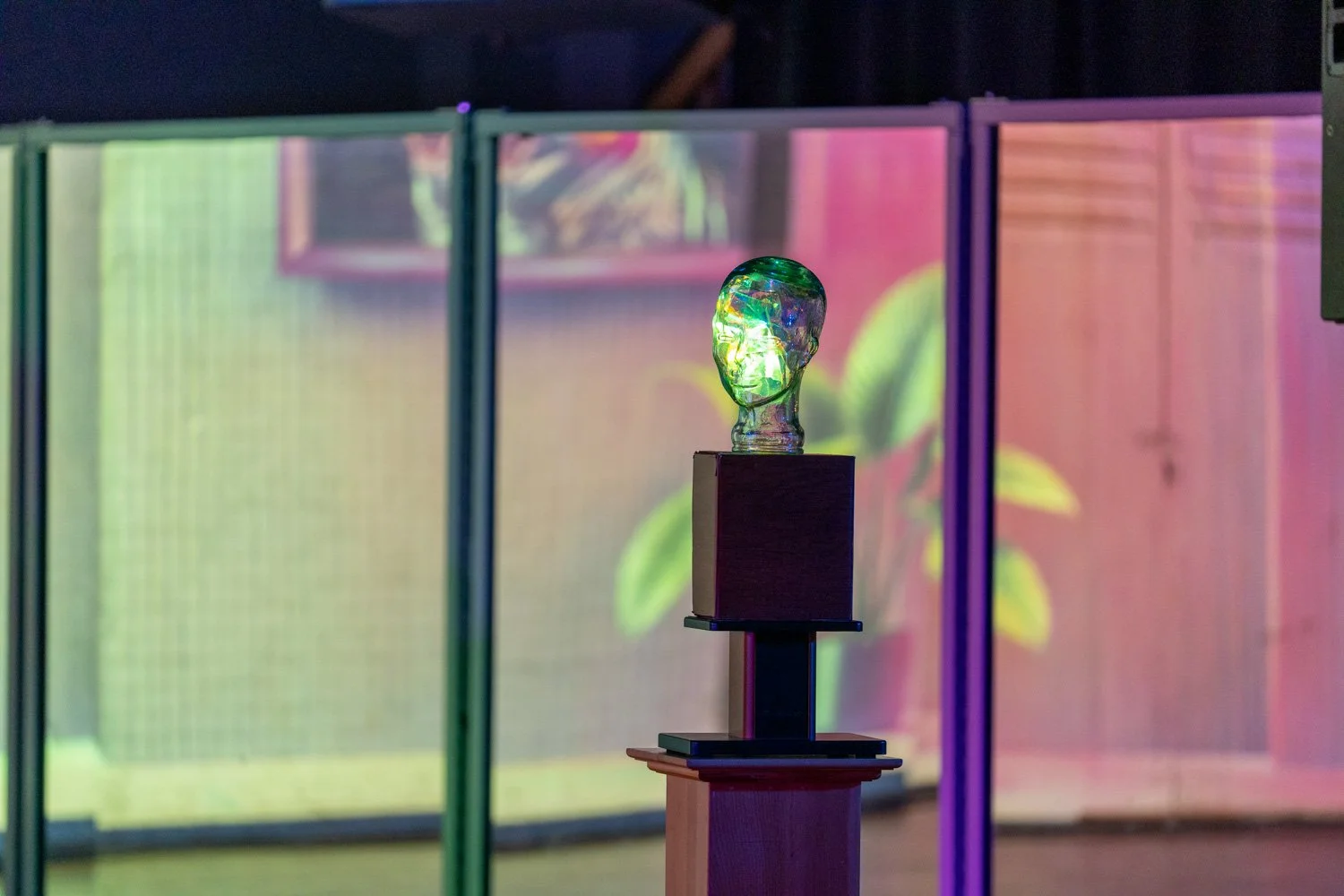
The flickering crystal head as your counterpart felt ominous, yet alluring. The contrast of it having no eyes or definitive features, yet its audacity to give such personal advice was a comical and chilling tight-rope to witness. How did you decide on these aesthetics and why didn’t you give it a body?
IH: I'd originally wanted to fill the head with a Pepper's Ghost illusion, which uses a scrim to produce an image hovering in empty space. It's a very old theatrical technique (first documented in 1589!) and it still feels magical today. But it didn't work. The head's neck was too narrow. So I ended up using dichroic film, on the advice of my circus artist friend Issac Endo, which created a more flickery, abstract effect.
For me the head is a physical manifestation of high-tech aesthetics: glass, teal, shimmery light, effortlessly "smooth" interfaces, as Byung-Chul Han describes them. But the head is also glitchy, like most supposedly seamless tech is.
I feel like the head does have a body, which is its podium! I staged it parallel to me, with the head close to human head height. If I'd placed it lower, on a table, I think it would read more like a puppet or tool I controlled. Giving it its own podium made it feel more autonomous, and, in my mind, ceded power to it.
I don’t believe you used AI for this piece, correct? But, it gives the illusion of AI being used with how the flickering crystal head speaks to you and the audience in the moment. Did you seek to create this aura of AI?
IH: I didn't use AI for the head's lines. Those were all (heavily) edited samples from the original recording. But I did use AI for other parts of the piece. I generated the first draft of one section of my script with ChatGPT because I wanted it to feel especially cliche and generic. I used Suno to generate the theme music, but also edited it in Ableton. The background images were made with ChatGPT. The ending (no spoilers) took several other AI tools to produce, including a noncommercial Python library.
I definitely wanted the audience to be thinking about AI throughout. There were lots of oblique references in the script to both AI and the Trump regime. I don't think you can easily separate corporate AI from fascism given the state of things right now.
I love how you used corporate culture as the vehicle for this performance. It’s something almost everyone can relate to and thus allows more kinds of people to access this type of experimental, new media performance they may not have seeked out before. What do you hope audiences take away from this piece and how do you hope it alters their relationship to the concept of work?
IH: Sometimes AI people talk about this hypothetical scenario: a paperclip factory, run by an AI manager, is tasked with maximizing productivity. Pursuing this goal at all costs, the factory consumes all resources on earth and destroys all life to produce a gigantic mountain of paperclips. This thought experiment is usually part of an argument for "aligning" AI to human interests. But we actually already have out-of-control paperclip factories that are actively plundering earth’s resources, ruining the biosphere, and producing mostly useless junk. They're called corporations.
Corporate culture likes to see itself as quirky and innocuous. Of course it does. But corporate aesthetics are performative constructs that function to make the corporate engine run more smoothly. The wardrobe, the email styles, the glorification of consumption, the abstraction of labor, the impersonal professionalism: all these things have class dimensions, and they all serve to make our complicity with fundamentally exploitative systems of wealth consolidation easier to accept and live with.
I think it's critically important for all of us to start seeing corporate power for what it is. It's not inevitable. All over the world, we need antitrust enforcement, meaningful regulation, and governance that prioritizes the commons. We need new cooperative models and local networks. We need to stop letting a tiny number of friendless, small-souled billionaires dictate the terms of our personal, social, political, and working lives. In the short term, here in the USA, we seem to be doomed to a hell of spiraling enshittification. But in the long term, anything can happen.